Parking Fee Guide
How to Avoid Paying for an Extra Hour of Parking
You’re almost done. The car is only a few minutes away. Then you realize your parking session is about to cross into another hour.
That’s when a short delay can turn into the annoying thought: “Did I really just pay for another hour because I was five minutes late?”
The best way to avoid extra parking fees is to know when the next billing period may begin, check how the parking operator charges partial hours, and set a parking reminder early enough to give yourself time to get back to the car.
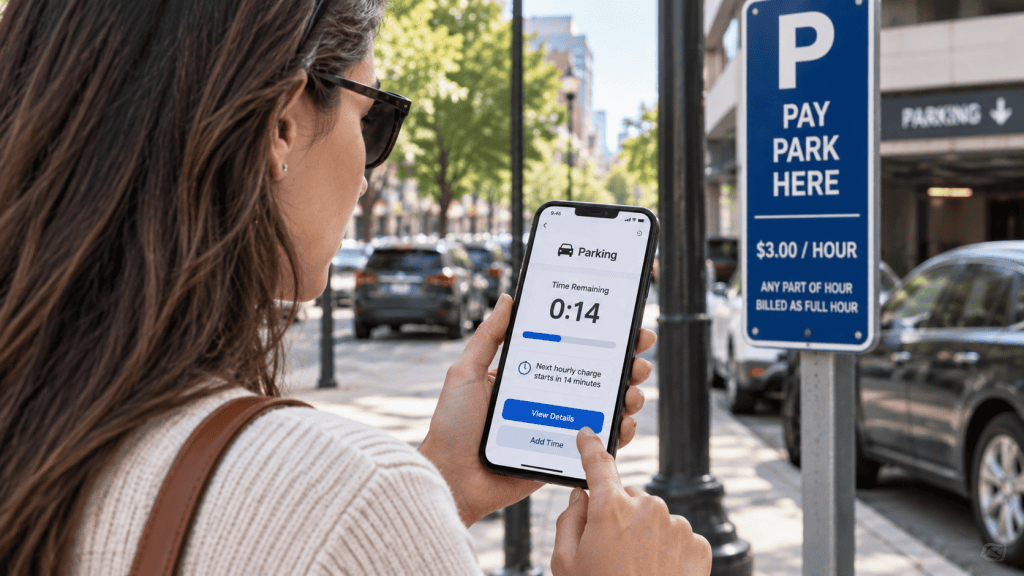
Can You Really Avoid an Extra Hourly Parking Charge?
Sometimes, yes.
If you know another billing period is approaching and you’re able to leave before it begins, you may be able to avoid paying for that next period.
But there isn’t one universal parking rule.
Some garages charge by the hour. Others charge every 15 or 30 minutes. Some charge for any part of another hour.
That’s why the first step isn’t rushing back to the car.
It’s understanding how that parking location actually calculates its hourly parking charge.
Why a Few Extra Minutes Can Cost More
Say the garage charges $3 for each hour or started hour.
You park for 1 hour and 55 minutes.
Your bill might still be $6.
You stay another ten minutes.
Now you’ve crossed into the next billing period.
Example only. Actual parking rates and billing increments vary by parking operator and location.
That’s how a small amount of extra time can become an extra parking fee.
Check How Partial Hours Are Charged
Don’t stop reading after you see “$4 per hour.”
The important question is what happens when you go beyond that hour.
Does 1 hour and 5 minutes count as two hours?
Does the next charge happen every 15 minutes?
Is there a 30-minute increment?
Is there a daily maximum?
Those details can make a big difference to the final bill.
Know Your Actual Parking Start Time
“I parked around noon” sounds good enough when you first get out of the car.
Two hours later, it’s not nearly as useful.
Maybe you actually parked at 11:47.
Now your mental estimate is already 13 minutes off.
If you’re trying to avoid extra parking fees, use the exact start time whenever possible.
Better:
11:47 AM — parked
1:47 PM — possible next two-hour threshold
Set a Parking Reminder Before the Next Fee
This is the easiest part to control.
If another billing period may begin at 2:00 PM, don’t wait until 2:00 PM to think about the car.
Set a parking reminder for 1:45 or 1:50.
That gives you time to finish what you’re doing and decide whether you actually want to leave.
Reminder appears
Start heading back
Possible next charge
A reminder doesn’t force you to leave.
It just means the next fee isn’t sneaking up on you.
Give Yourself Time to Walk Back to the Car
Leaving the restaurant at 1:59 PM isn’t the same as leaving the parking garage at 1:59 PM.
You still need to walk back.
Maybe there’s an elevator.
Maybe you’re on the far side of a shopping mall.
Maybe you need to load bags into the trunk.
Maybe there’s a line of cars waiting at the garage exit.
Build that time into your reminder.
Example:
3:00 PM
10 min
5 min
2:45 PM
Don’t Assume There’s a Grace Period
This is a risky one.
People often think they’ll probably get five or ten extra minutes.
Maybe that location has a grace period.
Maybe it doesn’t.
And even if there is one, it may apply to enforcement rather than the parking operator’s billing calculation.
If your goal is to avoid an hourly parking charge, don’t treat an assumed grace period as part of your planned stay.
The Extra Hour Usually Happens When You’re Busy
Most people aren’t sitting around watching their parking clock.
You’re having lunch.
You’re shopping.
You’re at a doctor’s appointment.
You’re meeting someone.
That’s why an extra parking fee often feels like it came out of nowhere.
You didn’t intentionally decide to buy another hour.
You just stopped thinking about the car for a while.
The useful question isn’t “How long have I been here?” It’s “How long until my next parking fee may begin?”
Stay Ahead of the Next Fee
A Parking Timer Can Make This Much Easier
You can do all of this with a normal phone alarm.
If you park regularly, though, a dedicated parking timer and parking reminder can make it easier to keep track of the session.
That’s what ParkGrace is built around.
ParkGrace can track your parking time, estimate your parking cost, and alert you before the next configured fee threshold approaches.
So instead of discovering another charge at the exit, you get a heads-up while you’re still able to decide whether to stay or leave.
1h 45m
$6.00
15 min
ParkGrace Features That Help With Parking Fee Timing
Parking Timer
See how long your current parking session has been running.
Parking Fee Reminder
Get a reminder as the next configured fee threshold gets closer.
Estimated Parking Cost
Keep an eye on what the current parking session may be costing.
Automatic Parking Detection
Use supported detection methods to help reduce the chance of forgetting to start a parking session.
ParkGrace doesn’t control parking rates or guarantee that you’ll avoid a parking charge. Actual fees depend on the parking operator and the rules at the location where you park.
A Realistic Example: Lunch Runs 10 Minutes Late
You park at 12:00 PM.
Another billing period may begin at 2:00 PM.
At 1:40, you’re still having lunch.
Nobody’s in a hurry.
Without a reminder, it’s easy to keep talking until 2:05.
Nothing complicated happened.
The reminder simply turned parking back into something you were thinking about before the next fee arrived.
Common Mistakes That Lead to an Extra Parking Fee
Extra Parking Fee FAQ
Related Parking Guides
Know Before Another Parking Fee Begins
Use ParkGrace to track your parking time and get a reminder before your next configured parking fee threshold approaches.